
Force Gauge PCE-DFG N 10TW
Description
FEATURES
SPECIFICATION
DOWNLOADS
Reviews (0)
DESCRIPTION
Force Gauge PCE-DFG N 10TW
Force Gauge up to 10 Nm / External torque transducer 1/2″ internal square / Graphic display / PEAK function / Sampling rate max. 1600 Hz / Incl. Software
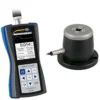
The force gauge consists of a handheld measuring device and an external torque transducer. The force gauge is connected to the hand-held device via a 1.5 m / 4.9 ft long cable and thus enables installation in a test stand or direct assembly on a test bench.
The force gauge is delivered adjusted so that the control measurements can be started immediately. A calibration certificate is optionally available for the force gauge. This certificate is a target / actual comparison on a traceable reference standard and thus serves as proof of the measurement accuracy. The measurement uncertainty of the torque measuring device is only 0.5% of the measuring range. The force gauge is therefore used as a reference device for testing and adjusting static torque tools. A screw latch is essential for dynamic torques.
The torque transducer has a 1/2″ square socket and can perform the torsion measurements in both directions of rotation. With a sampling rate of 1600 Hz, the force gauge reliably detects the first and the maximum torsional moment peak (PEAK). The release moment (” click “) is shown separately in the display and can be deleted either manually or automatically after a set time has elapsed. Thanks to freely adjustable alarm values, the force gauge can warn the tester of overload of the torque tool if it does not trigger itself. For a more detailed analysis of the torsional forces, the PC software included in the scope of delivery can be used.
HIGHLIGHTS
– Left / right torsion measurement
– 1600 Hz sampling rate
– Error limit 0.5% of the measuring range
– PEAK / Hold function
– Graphic display
– PC software
– Power adapter and battery operation possible
– 1600 Hz sampling rate
– Error limit 0.5% of the measuring range
– PEAK / Hold function
– Graphic display
– PC software
– Power adapter and battery operation possible
SPECIFICATION
| Measuring range | 0 … 10 Nm / 7.38 ft-lb |
| Resolution | 0.005 Nm / 0.00369 ft-lb |
| Accuracy | ± 0.5% of the measuring range |
| Units of measurement | Nm, lbfft, kgfm |
| Torque sensor mount | 1/2″ (12.5 x 12.5 mm) internal square |
| Torsion measurement | Left Right |
| Display | 2.8″ TFT graphic display |
| Alarm modes | Inside Outside |
| Sampling rate | 6 … 1600 Hz |
| Storage | For 100 measurement series with 8,000 measurement points each |
| Power supply | NiMh battery, 6V / 1600-mAh |
| Battery life | About 10 hours |
| Power supply / charging adapter | 12V / 1 A |
| Outputs | Interface: USB Switching output: 12V / 50-mA |
| Protection class | IP 54 |
| Operating and storage conditions | -10 … 50°C / 14 … 122°F 5 … 95% RH non-condensing |
| Torque transducer dimensions | H 85 mm / Ø 72 mm / Ø 104 mm (H 3.3 in / Ø 2.8 in / Ø 4.1 in) (see technical drawing) |
| Sensor cable length / td> | Approx. 1.5 m / 4.9 ft |
| Dimensions handset | 200 x 97 x 42 mm / 7.9 x 3.8 x 1.7 in |
| Weight handset | 540 g / 1.2 lbs |
| Weight of the torsion transducer | 985 g / 2.2 lbs |
DELIVERY SCOPE
1 x Force Gauge PCE-DFG N 10TW
1 x Torque transducer 10 Nm
1 x 1.5 m / 4.9 ft sensor cable
1 x PC software
1 x USB data cable
1 x Power supply
1 x Carrying case
1 x Sensor screw socket
1 x Instruction manual
1 x Torque transducer 10 Nm
1 x 1.5 m / 4.9 ft sensor cable
1 x PC software
1 x USB data cable
1 x Power supply
1 x Carrying case
1 x Sensor screw socket
1 x Instruction manual
FEATURES
Lorem Ipsum is simply dummy text of the printing and typesetting industry. Lorem Ipsum has been the industry’s standard dummy text ever since the 1500s, when an unknown printer took a galley of type and scrambled it to make a type specimen book. It has survived not only five centuries, but also the leap into electronic typesetting, remaining essentially unchanged. It was popularised in the 1960s with the release of Letraset sheets containing Lorem Ipsum passages, and more recently with desktop publishing software like Aldus PageMaker including versions of Lorem Ipsum.
SPECIFICATION
Lorem Ipsum is simply dummy text of the printing and typesetting industry. Lorem Ipsum has been the industry’s standard dummy text ever since the 1500s, when an unknown printer took a galley of type and scrambled it to make a type specimen book. It has survived not only five centuries, but also the leap into electronic typesetting, remaining essentially unchanged. It was popularised in the 1960s with the release of Letraset sheets containing Lorem Ipsum passages, and more recently with desktop publishing software like Aldus PageMaker including versions of Lorem Ipsum.